March 12, 2026
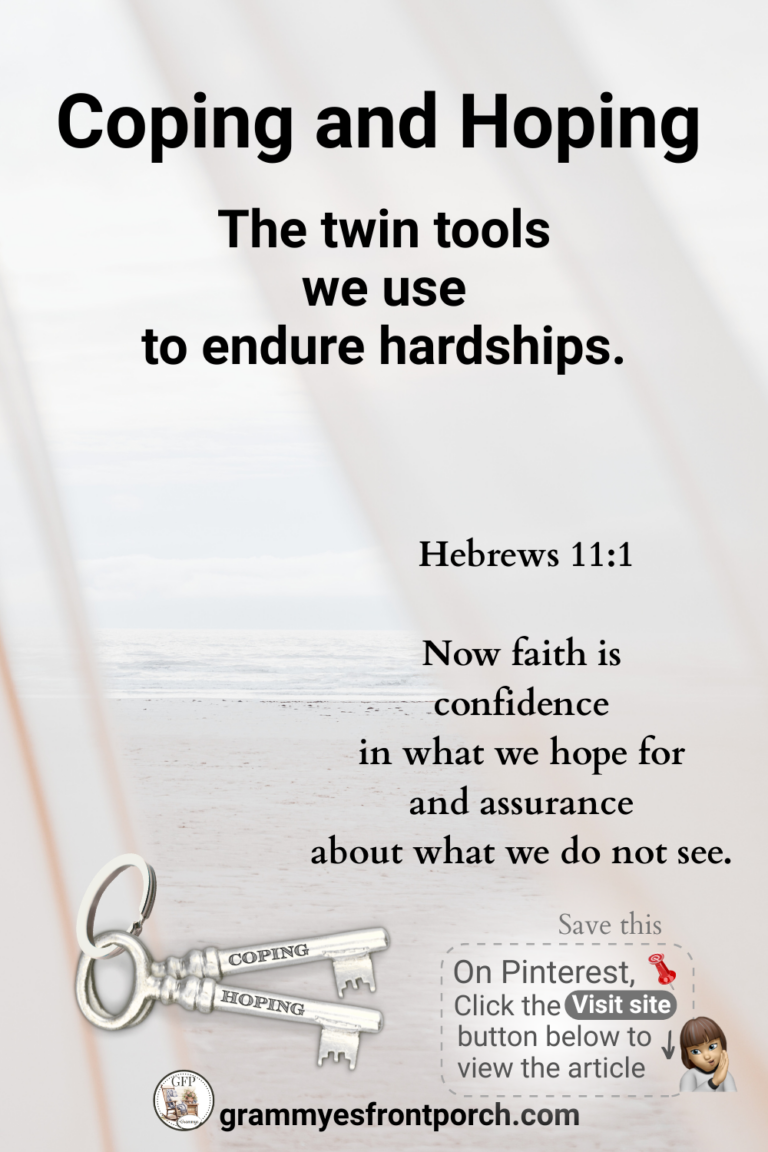
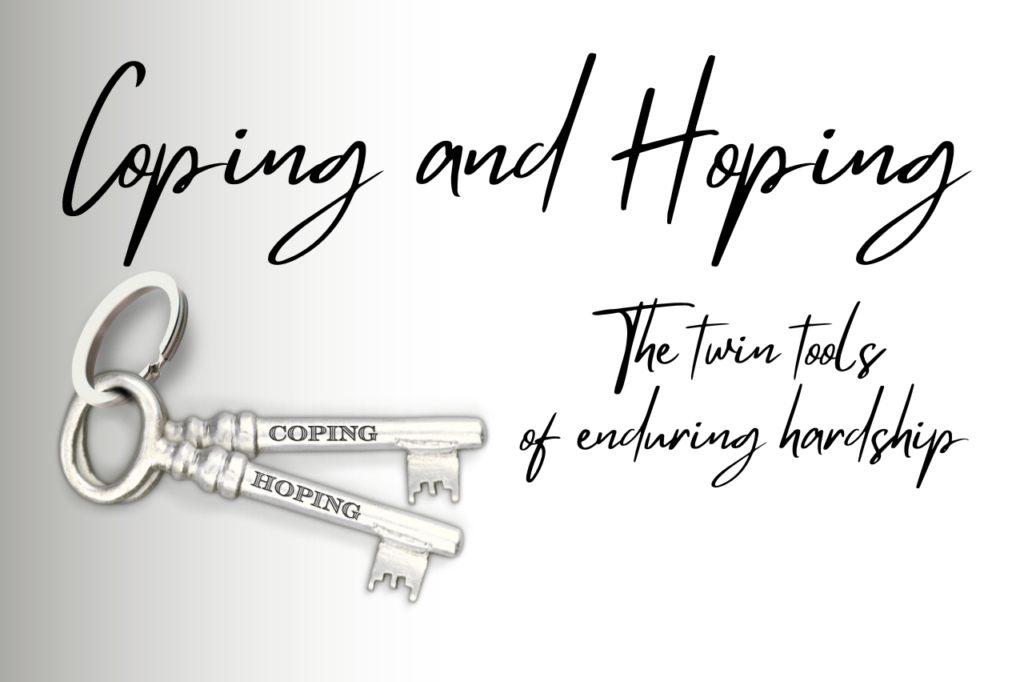
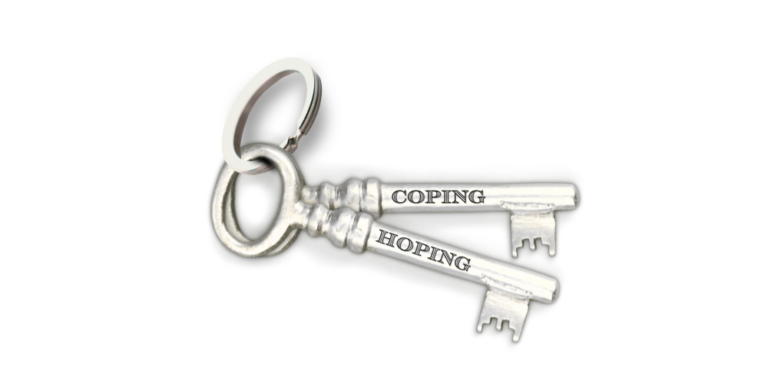
Enduring hardship. Coping, hoping — the twin tools of endurance. When hardships come, can you manage? These aren’t just tools. They are also predictors.
You need them both, and you won’t find them at Walmart or even Amazon. You have to grow them yourself.
ENDURING HARDSHIP -When It Happens
Hardship comes to everyone. We see it on the news, we hear of it from friends, and we even see it within our families and friends.
Especially in the South, we learn certain phrases to say. Little platitudes that are supposed to comfort. Of course they don’t, but we still say them. We also bring potato salad, evidently the one thing all Southern women can make on short notice.
We try to comfort others in their sadness, which is good.
But beneath all that there’s the quiet secret breath we let out, the one that expresses what we feel: Thank goodness it didn’t happen to me.
You know what? It probably will. In some form, you will receive news of something awful, something that all your life had happened to others.
I’m not trying to upset you. I’m just saying none of us are immune to tragedy.
ENDURING HARDSHIP -When It Happens to You.
When it all reverses, others come to you. Because you’re the one who experienced the loss. And you realize, fully realize, that no matter how much potato salad you eat, the tragedy is yours to endure.
You’ll accept their platitudes, their suggestions, and their help. You need it. You know the love behind it all.
But you need something so much more important, so much bigger, than these things. These expressions of kindness are outward mechanisms we all think are the whole story.
But now, you know. It’s your world that was upended.
Enduring hardship was just a phrase, until it was your turn. Now you see the effort that will be required.
Beneath the surface, there is an emptiness. A complete absence of logic, a vacuum of rationality. Numbness and disbelief may rule your moments. A complete pause in your thoughts, because your thoughts simply have no place to go.
And still, you must think. You must hear others and answer. The demand is greater than you ever imagined. The demand to function in the necessary things, the demand to manage, the demand to respond. All suddenly due when you have nothing to give.
When you strive for any kind of correctness, it simply isn’t there. You seem to have no ability to form words, no strength to act. You don’t know what is correct.
It’s awful.
And the plan here with this topic is not to respond to a tragedy, as much as that may seem to be the purpose.
The intention is to come to you with this terrible picture before you actually see it. Not to ruin your day, but to remind you that there is a need to accept this inevitability and to prepare for it, as best you can.
When coping and hoping are concepts you understand already, your endurance may be less burdensome. That’s what makes them predictors.
ENDURING HARDSHIP: Coping.
Coping is the life skill that helps us respond to difficulty. We cope with stress, negativity, and (unfortunately) tragedy.
The word isn’t something that comes up in ordinary situations, but it should. We should coach our children in coping, we should let others tell us how they coped. We should consider it as necessary as driving a car or using a cell phone. We should consider it an essential skill.
It would be nice if we could simply purchase a can of “Cope” when we need it. Or search for it online.
The fact is, coping is a skill and a habit, not a quick solution like a Band-Aid or Control + Z.
We try. We attempt to cope. But like turning on a faucet on display at Home Depot, nothing comes.
Coping is the well connected to the faucet. Without the source, the supply, the faucet cannot deliver.
Like playing the piano piece “Clair de Lune” by Debussy, we can’t cope until we have practiced extensively. Until we have heard the music of coping, and understood how it progresses.
I’ve probably said too much about coping, without defining it.
Exactly What is Coping?
It’s this: to deal with and attempt to overcome problems and difficulties.
And let me say it clearly: I’m telling you to learn about coping before you need it. You may reflect on past experience, or you may seek input from a trustworthy mentor. We all need to understand coping before we need it, while we have the capacity to understand what it is.
A very straightforward list of advice appears in this topic from Cleveland Clinic, Coping Skills and Strategies.
And for perspective on grief, Coping with Grief and Loss from Helpguide.org has some explanations and advice that are probably helpful.
Direct help, though, comes from people who care. From a trusted friend who has coped. And from a pastor, a counselor, or a support group. Or all of these.
Consider learning about coping as a worthy project to tackle in times of peace.
Because enduring hardship isn’t just a posture. It’s the hard work of standing up and taking steps forward.
Today is about two important tools to add to your toolbox. Coping is the first one. But it can’t work alone.
ENDURING HARDSHIP: Hoping.
My personal opinion: These tools are both essential.
Coping is the tool you use constantly, so that the work gets done.
But hope. Hope is the blueprint, the house you’re building, the project that goes on. The worthy plan that is your purpose. It’s why you need to cope in the first place.
Can I explain “hope” here? Sure. In a basic way. Like Merriam Webster:
- to cherish a desire with anticipation : to want something to happen or be true
- to desire with expectation of obtainment or fulfillment
- to expect with confidence.
These are correct. And they sound nice, but I wouldn’t trust them to hold up the whole house.
Stepping back to look at the worthy project that is my life, “hope” has a richer meaning and a more solid purpose.
In “What Is Hope” from Desiring God, we explore the concept of “hope” in Scripture. It is a beautiful journey through our own language and then through the Bible. I encourage you to read the article, one of many that will help you digest the explanation in a way that is easily understood.
From the article:
Biblical hope is a confident expectation and desire for something good in the future. There is moral certainty in it.
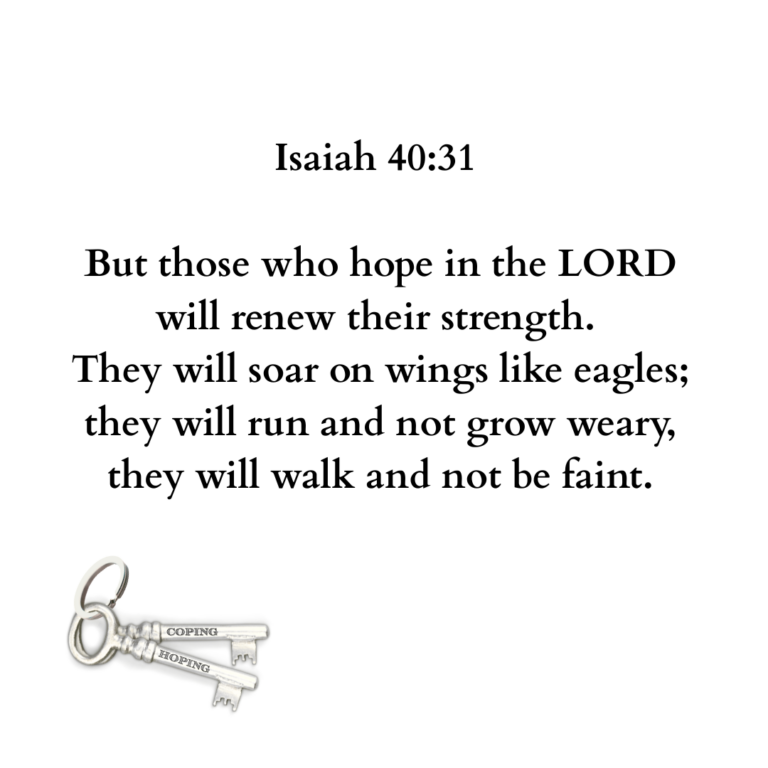
Hope, then, is the plan and purpose. Cope is the work we do to navigate the course.
Hoping is the knowledge that the promise is bigger than the pain. Coping is the action we take in the difficulties.
Coping and Hoping: The Truth About the Twin Tools of Endurance
We tend to live in a perspective that leads us to expect comfort and prosperity.
Whether our course has simply been without difficulty, or we feel that we have “earned” an escape from sadness, we may have failed to develop an ability to cope.
We may also have failed to look at the hope of our future.
These failures can be those secret sins of neglect.
I just said “neglect.” And I said “failure” twice, didn’t I? I’m sorry. But these failures, they’re like tasks that were missed. I failed to put the socks in the hamper, or I failed to go to the mailbox earlier. They’re fixable.
What We Often Neglect
What do I mean by neglect?
Neglect doesn’t look at the overt sins we define and see, but points out the absence of what should be present.
If you don’t try to think about it, you won’t.
It’s this: Things we didn’t do often escape our attention as mistakes. Because we can’t see them.
This isn’t made to make you feel bad. It’s just a reminder of two things: Many failures are fixable, and many errors are invisible.
You’re not getting scolded. You’re just getting tolded.
You see it, right? How important these two concepts are? Coping and hoping. And how important it is to put them together before it’s your turn.
Why now? Because anytime I’m struggling with something, I want you there with me. Looking at the reality of disappointments and tragedies, and the need to respond.
Something Bad Happened
Sad things have unfolded nearby. I’m relieved to be the person who brings the potato salad. But next time, it may be my turn to receive it. (It’s a metaphor this time; I didn’t really bring any.)
And I wonder if the sad family near me has the strength to cope and to hope. Not because I’m judging them, but because I know that deep need. The need to cope, and the need to hope. The well we must dig and fill, before we can use the faucet.
I am grateful for an upbringing that cultivated coping and hoping in a number of ways. Grateful that even as a young person, coping and hoping were tools already in my toolbox.
But what about you? Did someone offer you that training? Is it something you might talk about with your children as they grow up?
Remember, I’m just me. Not an educator, not a counselor, not a pastor. I’m your friend who says, “Let’s think about things deeply.” Especially about enduring hardship. Especially at a time when you didn’t want to.
Why, then, did I come to you with this?
Because of need.
Because of struggles.
Because of friends who allowed me into their trials, and entered mine.
Because those around me insisted I work out spiritually, developing my coping and hoping muscles.
Preparing is not the same, however, as prevention.
Strength is not the same as safeguarding.
Troubles will come. Troubles that seem to destroy.
I pray daily that you and I are spared from heartbreak.
And I also pray daily that we are able to remember our hope.
I hope you, and the people around you, are intentional about coping and hoping.
I hope you know that God redeems the worst things.
And I hope you know Him.
By the way, 😎
Some of the products mentioned as links on this page are affiliate links. That means a merchant may give me a tiny reward if you buy something I recommended to you. Tiny rewards like that, plus the sale of my own products, help to reduce the ongoing cost of the blog. (Or, as my husband calls it, my expensive hobby. 😉)
Find out more about that here.
Thank you for visiting! At GFP company is always welcome!
If you liked this topic, feel free to
share
on Facebook or Pinterest, or send a link to a friend.

Are you on Pinterest? That is a crazy fun place! You can find so many helpful things. Take a look at what I’ve saved for you! A lot of things that never make it to the blog. Here are my Pinterest pins, and I have lots of categories/boards if you’re looking for something specific.
-Grammye
New here?
I’m Grammye, and I’m collecting and sharing ideas that can help you embrace the life you have.
When things are difficult, come here to refresh and relax. We’ll have coffee and talk.
You’re invited
to the neighborhood of GFP.
Accept by signing up
and I’ll send you a letter right away.
Subscribing to GFP is just like getting a magazine. Except it’s free! You won’t be asked for any payment information.
So say yes, then check your junk/spam mail in case the confirmation gets lost on the way!
This post may contain affiliate links. That’s a good thing. It means if you purchase a product I’ve highlighted, the seller may compensate me for that promotion. I love to share products that are a good value and make life easier. Those little commissions may add up, and can help to offset the cost of running the blog. Or maybe even create a little income. Click here to learn more about this.