
October 24, 2025
If you’ve wondered how to help with homework hate, you’re not alone. It’s not just the students. Parents hate homework, too. Today, we talk about managing the dreaded homework task.

Homework Hate
Why wouldn’t we hate it? Every day is the same: Homework takes way too long, kids are grumpy and reluctant to do it, and parents are at their wits end.
Situations are different, but unhappiness is the same.
Here are some of the issues:
- Do students need to complete homework while parents are at work? Maybe they just don’t do it.
- Do students have parents present during homework efforts? Maybe it creates tension in the family that shouldn’t be there.
- Do the assignments tend to be confusing or even impossible? Maybe those who are not educators are frustrated at the expectations.
So maybe students don’t complete their homework, maybe homework creates family tension, or maybe the expectations are not reasonable.
Before everyone declares it all a lost cause, take a minute. Let out that breath you’re holding, and agree on something: that we’re experiencing this and we need a solution.
And remember: I’m not an educator, either. Just a lady looking for peace in the afternoon.
Take just a quick look at what’s happening “out there,” and then we’ll jump right in.
Help For Homework Hate
I want to point out that there are people campaigning to eliminate homework. There is a good case for taking that position. Maybe you’ve even been a part of that movement. In some districts, homework has been eliminated.
Also, the proponents of homework have a good case as well. Saying it’s beneficial. Why? Independent study skills, completion of curriculum requirements, and parental awareness of learning materials are some of the reasons.
You’re not alone. If homework is disrupting your family life, plenty of others feel the same way.
And if you like looking over their lessons and seeing how they’re being taught, there are plenty of parents who agree.
In either position, there is hope for you.
And, just so you know, today’s help won’t be settling that debate. Here’s the task for today:
If your child has homework, what can you do to keep it from ruining your lives?


Helping With Homework
There are ways to cure the homework hate. Things you can do to make it better.
In general, we are trying to ease the dread and make the conditions more pleasant. Instead of feeling defeated, let’s change the game.
It’s so empowering to decide to make a change.
So…
TAKE CHARGE.
Step back and look at things as a new manager would, called in to inspire the troops, restore order, and increase production.
The assignment you accepted is to correct the issues so that homework can proceed with success.
Your improvements could be implemented by considering three things:
Create a routine that is expected. The exact order things will be done. Come home, have a snack, get the homework done. This is great to do before they change gears and start focusing on amusement / not thinking. Teachers know what gets kids off track. Parents aren’t trained to be so aware. All we know is that it’s off track.
Create an environment that is comfortable, conducive, and distraction free. No TV shows running within the zone. Supplies are handy. Space is adequate. Because interruptions and lack of equipment (pencil sharpeners, paper, etc.) can derail efforts and lengthen the time it takes. And give plenty of space between kids. Otherwise… well, you know.
Be “kindly” available. Maybe that’s an odd way to word it, but let’s say it’s the opposite of “resentfully available.” You can be preparing dinner, quietly cleaning, or something else. But consider it your part to be calm, encouraging, helping, and available. Don’t let questions or whining get you off track. Respond with kindness and firmness, and an expectation that the task will be completed.
If you’d like tips on setting up a homework zone, check out “How to Set Up Your Kitchen for Kids.” The tips there are helpful for routine and environment.
And now, let’s talk briefly about the role of a homework-supervising parent.
Homework Makes You Hate
The most loving and patient folks (both parents and students) can lose their minds over homework. Those with short fuses can certainly get to that end much faster.
You start out with good intentions, but soon you’re helpless, hopeless, and even heartless. You hate the homework, you’re hurt with the teacher, and you harm your own kid’s self esteem.
Which is the last thing you wanted to do.
None of us wish unhappiness on our kids, none of us want them to feel incapable, or “less than.”
So it helps to recognize that you’ve stepped on the hamster wheel and you are stuck in a sequence that ends up the same every day. Pleading, threatening, and everyone ending up completely unhappy.
So step off for a minute, and pause. Think about the reality. And shift your perspective to something more long range than this moment ( 😉 when you want to throw up your hands, and say “I give up.”)
Why Parents Should Transform Homework Time
Maybe your son or daughter is a child, elementary age, with little understanding of study habits, how education builds on itself year after year, or the value of knowledge in the workplace.
(Elementary: “Why do I need this?” They really don’t know.)
Maybe you have a teen, someone who is spending time in that illusion: that school is hard work, and being a grown-up will be the end of that pesky truth. Thinking that after school they will be on Easy Street.
(Teen: “I’ll be glad when I’m DONE with learning.” They’re in for a surprising truth, right?)
All that to say: You know some important stuff they don’t.
As parents, you want the very best for your child. For them to be properly educated, for sure. But also for them to have earning potential and respect as an adult.
So here we are, loaded down with long-term goals, and we have a child crying every single day because subtraction is just too hard.
We all have learned to subtract, but for your little one, they really are feeling like they can’t do it.
That’s why you’re here. Let’s talk about how to help with homework, and I’ll give you resources that will support you with instructions, ideas, and encouragement.


How to Help with Homework Hate
Two things here.
The first thing to nail down is your intentions. Second, your positioning.
Once you’re clear on those two things, taking action is a natural next step. But it takes a minute of pause to be able to focus.
Let’s look at both:
Intentions
It’s pretty easy to state your intentions.
To help your child learn and advance.
Specifically, to help your child understand and to retain the knowledge.
And in the process, to help your child develop good study habits and motivation to use them.
To help your child learn how to be successful, as a student, and as a person.
Putting intentions/goals into words is pretty easy. Each one of those contains the phrase “to help your child.”
But there’s something else: Your positioning.
It’s not something we discuss often, and when you hear others speak about it, you realize we don’t give it enough attention.
Positioning Yourself To Help
Positioning has to do with being prepared. It is a part of knowing your responsibility, and being ready to carry out your duty.
Placing yourself.
Like a soldier, a ball player, a speaker, or a judge.
Being in the right place at the right time with the right mindset and the right preparation.
If you really listen to the language of positioning, you can’t help but be impressed.
What is the language?
It sounds like this:
- We need to get out in front of this.
- Take charge early.
- You’ll need to be ready for questions.
- Let’s be proactive here.
- Be ready to react.
- Be forward thinking.
- Be ahead of the game.
- Be resourceful.
- Be the authority, ready to make decisions and take command.
All these are different ways of considering your upcoming task and being prepared to produce the right result.
Often this type of language is used at work, but we don’t utilize the same logic when we’re home.
Solving Homework Hate With Leadership
You know exactly what I’m doing, don’t you?
Telling you that you have the authority and the responsibility to oversee homework and to lead your child to a place of self discipline and self motivation.
Why is that important?
You already know that, too.
I’m telling you it’s noble and good and worthy. Which has a huge impact on your attitude and performance.
Maybe you’re already thinking of it this way. But most of us don’t.
Most of us enter the homework time with an attitude of annoyance, frustration, or impatience. Why wouldn’t that be contagious?
What Do We Expect?
The power of expectations is so underestimated. So embedded in our subconscious.
Walk into any place and notice that your behavior adapts to your expectations.
For instance:
- A trampoline park.
- Church.
- The doctor’s office.
- A classroom.
- Krispy Kreme.
We have learned what will happen in each place, and our bodies actually begin the process of reacting. Our mindset, body language, and even heart rate will adjust to the setting. We might even salivate. (It’s real, and you know it.)
And this is exactly what happens when you drag those backpacks to the kitchen table. The mind and body react in a tangible way.
This is the place that makes me frustrated and helpless and defeated. This is the place that makes me cry.
A setting no one wants to enter.
Could we change that?
You Already Have the Power to End Homework Hate
Just like Glinda told Dorothy, “You’ve always had the power, my dear. You’ve just had to learn it for yourself.”
You have the authority and the responsibility to oversee homework and to lead your child to a place of self discipline and self motivation. It’s noble and good and worthy.
Lead Your Child to Self Discipline and Self Motivation
Once you reframe your role, things shift a little.
Yesterday, you and your child both trudged into the kitchen with eye rolls and negative comments. You dreaded it, and so did your child. Both of you set the pace to resent it from the get-go. You helped your child drag out the books and papers, and began to struggle through it with increasing frustration and terse words. You talked about the difficulty and the uselessness. Also the unfairness and the evil motive of the person who assigned it. And so on.
That was before.
Today, you’re quietly thoughtful. You’ve reviewed the supplies and gotten them organized. You show mild interest in the assignment, making a comment about the details. And then you wander a few feet away to make that grocery list or fold laundry.
You keep reminding, keep focusing, keep gently encouraging. You don’t criticize or scold, but you’re different. You don’t join in when the grumbling starts. You’re conversational, but not negative.
Your kid notices it immediately. (“What happened to her?”)
You’re different. You’re not in the ditch anymore. You separated yourself from the negativity. You’ll get the side-eye and a lot of questions.
Your explanation? You’ve just been thinking today about…
- How beneficial it is to be educated.
- How it levels up your ability to deal with things.
- How it’s a luxury in many places in the world.
- How satisfying it is each year to know what you didn’t know at the beginning.
You don’t have to say all this the first day, but it’s a part of your new attitude. Let it leak out a little bit every time you’re helping.
- You mention how much more your child knows this year, how much has been learned.
- You acknowledge the hard work, and show respect and admiration for the willingness to keep going, even on the hard days.
- You compare your “easiest” and “hardest” subjects with your child, and talk about it.
If there’s a question, or even some kind of real struggle, you give it your attention and think out loud as you review what needs to be done. You’ll count this as “together time” telling little stories about your own schooling, and showing your child how to find ways around the obstacles.
You’ll do the same tomorrow and the next day. Until your student is more willing. More settled. Hard at work, taking a little pride in the work and finishing a little earlier. With you nearby and available.
And Look At You!
Look at you. Modeling patience and determination, respecting the task, and championing your child.
Leadership, applied to a developing young leader.
You haven’t just solved the homework problem. You’ve solved a coping problem. You’ve increased resilience. You’ve established good habits. You’ve affirmed the value of learning.
I’m not promising magic. But I am reminding you of the power of leadership.
Wouldn’t your child be grateful if you had the insight and the foresight to remove some of the stress of homework?
Wouldn’t it be healthy for both of you to team up and be allies in accomplishment?
Wouldn’t it be a powerful thing to do, conquering a negative thing (homework hate) and turning it into a positive one (managing homework)?
Leaders teach people to perform, to progress, and to cope. They teach problem solving, positive thinking, and resilience.
Resources for How to Help with Homework
Maybe this got you thinking, and that is great.
Maybe it didn’t solve your problem. Maybe you need more ideas, or more solutions than you found here.
For more information on practical ways to help, check out these articles:
Focus on The Family’s topic of Parents’ Role in Homework.
Edmentum’s 9 Homework Helping Tips for Parents.
Scholastic’s How Parents Can Help With Homework Without Taking Over.
Parent Powered Decoding Strategies.
Of course there are many more.
Do Fun Things in your Homework Space
You know what else?
You can lighten up the mood of your kitchen table (or wherever you do homework).
Make sure other projects (fun ones) are done in your “homework space.” This can help reinforce that happy-to-be-here feeling you’re after. Legos, puzzles, art projects, etc..
Interested in Creative Writing?
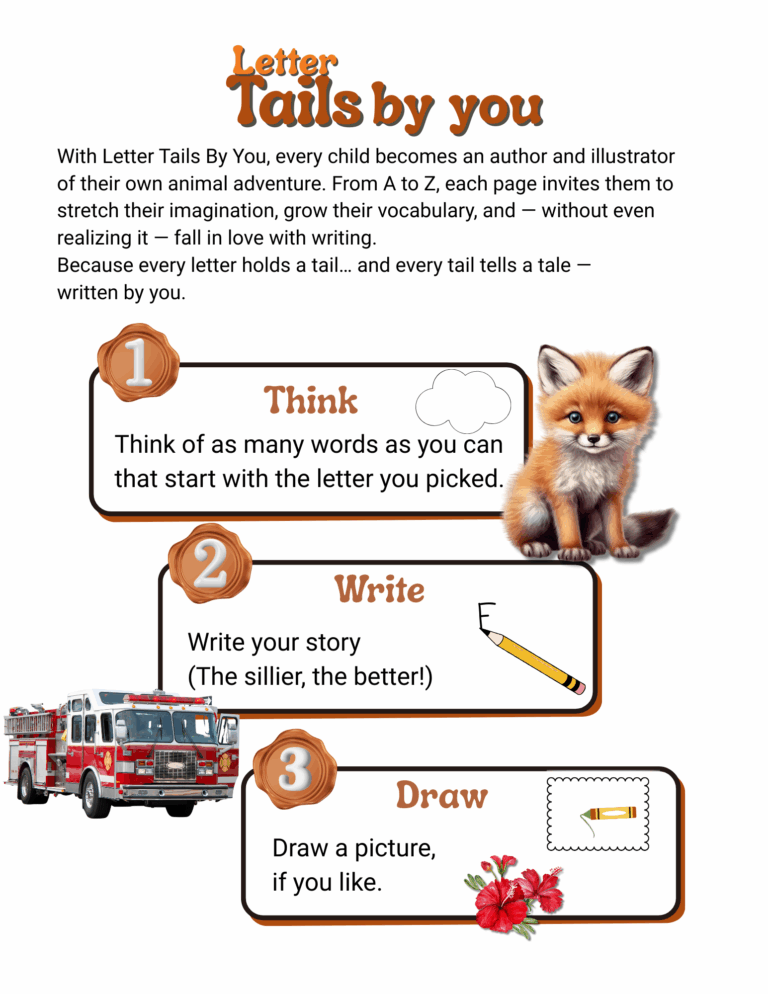
If you’d like a jump start on enjoying the process of learning, try my creative writing for kids workbook. It’s called Letter Tails by you.
It’s not like other books — this one insists you get silly.
It can be loads of fun to sit down and draw or write with your child. Especially when you can laugh and get goofy. And it’s fun to return to those stories you create.
Learning takes lots of forms, and this one can open some doors that looked like they were nailed shut.
If you’re looking for fun, click one of the images below to find out more.

If forming words with the pencil is difficult, maybe your child is still discovering that skill. The basics of reading are covered in Kindergarten, First Grade, and Second Grade. Reinforcing those skills is super important at this age. If your child is older but still having trouble, maybe reviewing will help.
Phonics Workbook
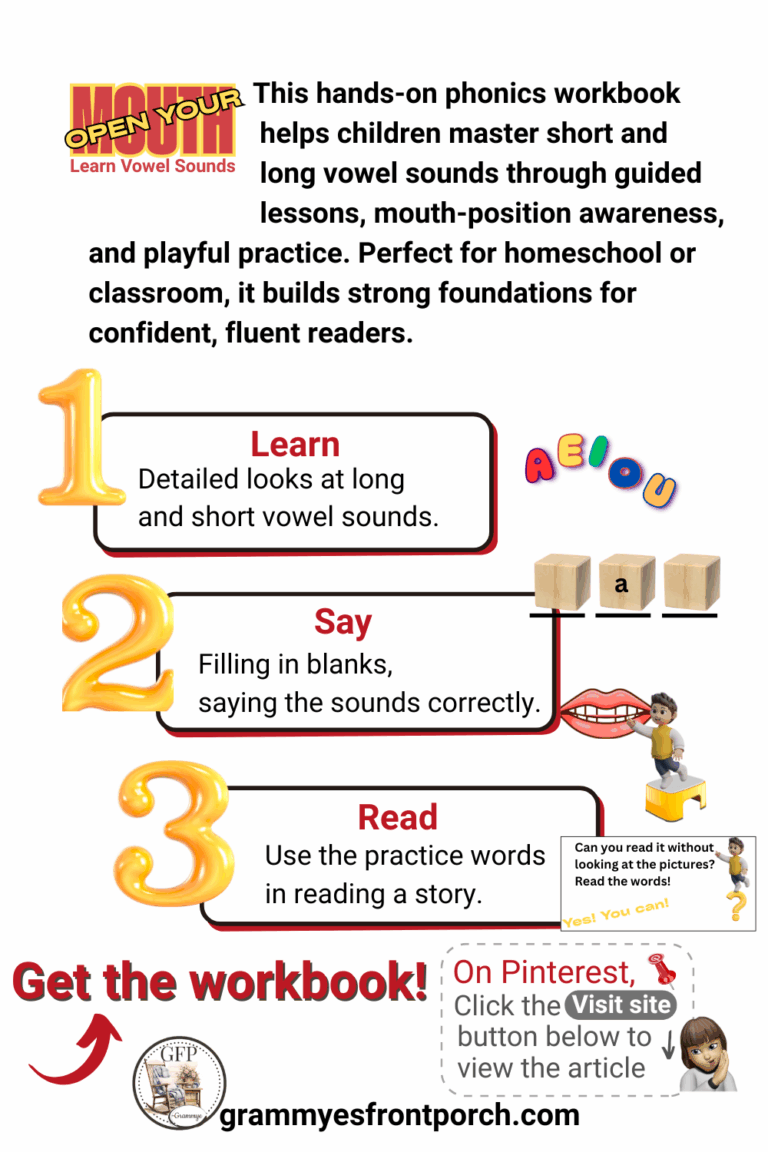
Here’s a cute phonics book that carefully separates long and short vowel sounds in a pretty memorable way. We’ll call it a workbook, but it’s a funbook. Open Your Mouth.
Let the cute host take you through all the vowels, with extra attention to the “short” vowel sounds.
By the time you’ve filled in letter blocks and watched this little guy inside a slobbery mouth, you’ll be smiling your way through the cute story at the end. It’s a short and fun trip to actually being able to read a story.



Hoping this Helps with Homework Hate
Mom, it’s you I think of and pray for, because what you do is difficult and important.
How grateful I am that my mom valued education and all that goes along with it. She didn’t need me to be a college professor. She simply needed me to understand that there was always more to learn.
She made it clear that her mom held that view also, and always reminded me it would only take one generation to lose it all.
It’s a gift I tried to pass along to my own children, and now to my grandchildren.
Because… That love for learning — when you get something so wonderful, you just want everyone else to have it, too. 💝
Start early, creating a healthy and energetic homework environment for your child.
Start early with the love of learning, and the dignity that comes with being knowledgeable.


By the way, 😎
Some of the products mentioned as links on this page are affiliate links. That means a merchant may give me a tiny reward if you buy something I recommended to you. Tiny rewards like that, plus the sale of my own products, help to reduce the ongoing cost of the blog. (Or, as my husband calls it, my expensive hobby. 😉)
Find out more about that here.
Thank you for visiting! At GFP company is always welcome!
 If you liked this topic, feel free to
  share
share  on Facebook or Pinterest, or send a link to a friend.

Are you on Pinterest? That is a crazy fun place! You can find so many helpful things. Take a look at what I’ve saved for you! A lot of things that never make it to the blog. Here are my Pinterest pins, and I have lots of categories/boards if you’re looking for something specific.
-Grammye
New here?
I’m Grammye, and I’m collecting and sharing ideas that can help you embrace the life you have.
When things are difficult, come here to refresh and relax. We’ll have coffee and talk.

You’re invited
to the neighborhood of GFP.
Accept by signing up
and I’ll send you a letter right away.
Subscribing to GFP is just like getting a magazine. Except it’s free! You won’t be asked for any payment information.
So say yes, then check your junk/spam mail in case the confirmation gets lost on the way!

This post may contain affiliate links. That’s a good thing. It means if you purchase a product I’ve highlighted, the seller may compensate me for that promotion. I love to share products that are a good value and make life easier. Those little commissions may add up, and can help to offset the cost of running the blog. Or maybe even create a little income. Click here to learn more about this.